
How Do I Build Systems So My Business Runs Itself?
Build systems so your business runs itself by following one loop: systemize, document, automate, then delegate — one repeatable task at a time.

Evolvv Strategies
Operator notes
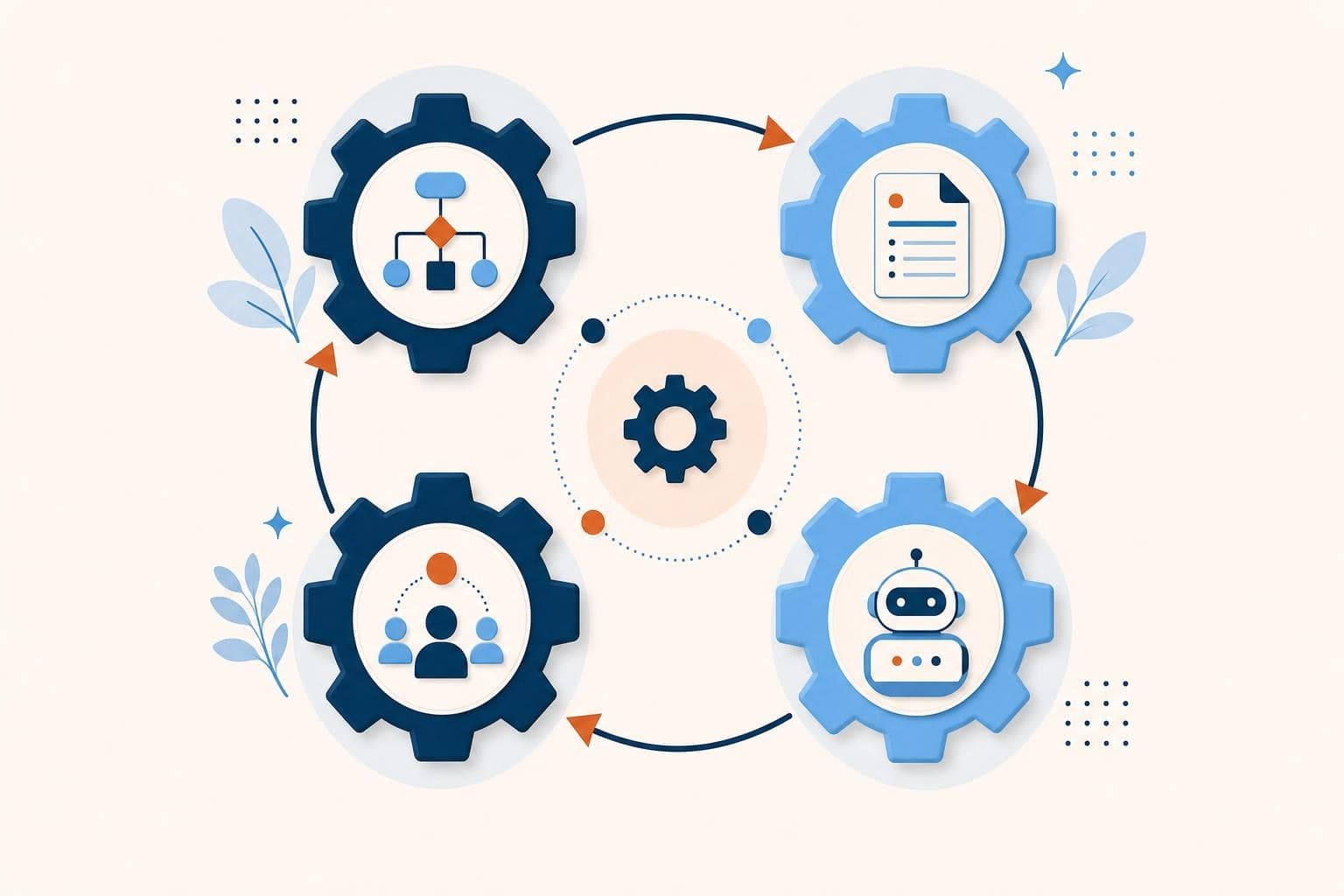
Build systems so your business runs itself by repeating one loop on every recurring task: systemize it into clear steps, document those steps, automate what software can handle, then delegate the rest. A business "runs itself" when its core work depends on reliable systems instead of your constant attention.
"Runs itself" is a slight myth — every business needs a hand on the wheel. But there's a real version of it: a business that keeps delivering when you step away for a week, because the work doesn't live or die on you.
That doesn't happen by hiring harder or working longer. It happens by building systems, one loop at a time.
Why systems beat willpower
Most owners try to scale on personal effort. They become the human glue holding everything together — answering every question, fixing every mistake, remembering every detail. It works until it doesn't, and then they hit a ceiling made of their own hours.
Systems remove you as the single point of failure. A documented, repeatable process produces the same result whether you're in the room or on a beach. That consistency is what lets a business grow past one person's capacity — and what makes it actually worth selling someday.
A business runs itself when the work depends on reliable systems, not on you remembering everything.
In 15 years of building businesses, the difference between the ones that scaled and the ones that stalled was almost never talent. It was whether the owner built systems or tried to hold it all in their head. The system-builders grew. The glue-holders burned out.
The four-step loop that turns chaos into a machine
You don't build all your systems at once. You run this loop on one task, then the next, then the next. Over months, your business quietly becomes a machine.
- Systemize. Take a recurring task and define the exact steps and the result it should produce. Turn a fuzzy "we kind of do this" into a clear, repeatable sequence.
- Document. Write the steps down — or better, record yourself doing it — so anyone can follow it without asking you. Undocumented systems still trap you.
- Automate. Hand the boring, rules-based parts to software. In 2026, tools and AI can handle scheduling, follow-ups, invoicing, data entry, and routine replies for next to nothing.
- Delegate. Give the documented, partly-automated process to a person. Because it's clear and repeatable, they can own it without you hovering.
Then you measure whether it's working, fix what breaks, and run the loop on the next task. That's the whole engine.
Where automation actually earns its keep in 2026
Automation has gotten genuinely good, and a small business can now offload work that used to need a hire. But the order matters: automate after you've systemized and documented, never before. Automating a messy process just gives you faster mess.
The highest-value targets are the repetitive, rules-based tasks that eat your week: appointment reminders, review requests, lead follow-up, invoicing, basic customer questions. Modern tools and AI assistants handle these reliably and cheaply. Connecting your existing apps so they pass information to each other — no manual re-typing — often saves hours a week on its own.
What you don't automate is judgment, relationships, and the work customers value because a human did it. The goal is to free your time from the robotic stuff so you can spend it on the parts of the business only you can do.
Quick wins you can try this week
- List your ten most repetitive weekly tasks and circle the three that drain the most time.
- Run the four-step loop on just one of them, start to finish.
- Screen-record yourself doing that task once and turn it into a checklist.
- Automate one thing this week — reminders, review requests, or invoicing.
- Connect two apps you currently copy data between so they talk to each other.
FAQ
Can a small business really run without the owner?
Mostly, yes — though every business needs occasional direction. The realistic goal is a business that keeps delivering reliably when you step away for days or weeks, because the core work runs on documented systems rather than your memory. Get there by systemizing tasks one at a time until you're the strategist, not the bottleneck.
Should I automate or delegate first?
Systemize and document first, then automate the rules-based parts, then delegate the rest to a person. Automating a process you haven't clarified just speeds up the mess. Once a task is clearly defined, let software handle the repetitive pieces and a person own the judgment — that order gives you the cleanest, most reliable result.
What should I never automate?
Don't automate judgment calls, important relationships, or the human touch customers specifically value. Automate reminders, follow-ups, scheduling, and data entry — not the personal conversation that closes a big deal or resolves a sensitive complaint. The point of automation is to free your time for the high-value human work, not to remove the human from where it matters.
How long does it take to systemize a business?
It's ongoing rather than a one-time project, but you'll feel relief within weeks of starting. Run the systemize-document-automate-delegate loop on your most repetitive task first, and you reclaim hours almost immediately. Keep applying it task by task, and over several months your business transforms from owner-dependent to system-driven without any single overwhelming push.
Want to know which systems would free up the most of your time first? A free Growth Audit pinpoints them — or explore our services for operations and automation.