
What Is a Sales Funnel and How Does It Live on My Website?
A sales funnel is the path from stranger to customer. On your website it's the deliberate flow of pages and CTAs that guides visitors to one clear next step.

Evolvv Strategies
Operator notes
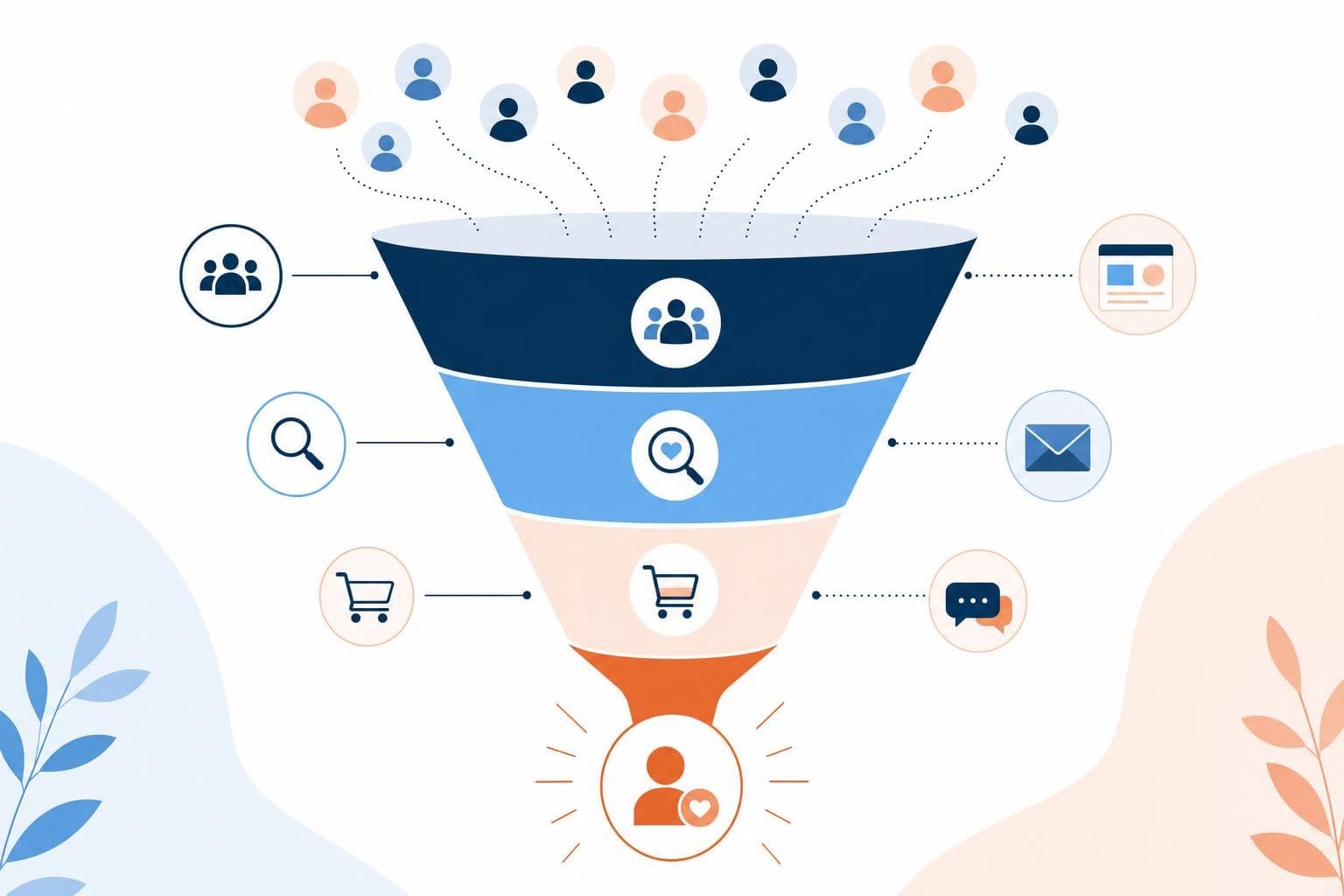
A sales funnel is the journey a person takes from first hearing about you to becoming a paying customer — awareness, interest, decision, action. On your website it lives as a deliberate flow of pages and calls-to-action that guide each visitor toward one clear next step, instead of leaving them to wander and leave.
The word "funnel" makes it sound technical. It isn't. It's just the path your customer walks, and whether your website paves that path or blocks it.
Most small business sites have no funnel at all. They're a pile of pages with no obvious direction — and a visitor with no direction does the easiest thing available: nothing.
The four stages, in plain English
Every funnel has the same four stages. Your job is to meet the visitor at each one and gently move them to the next.
Awareness is when a stranger first finds you — a Google search, a social post, a referral. Interest is when they think "maybe these are my people" and start poking around. Decision is when they're comparing you to the alternative and looking for reasons to trust you. Action is when they finally book, buy, or call.
A funnel isn't about tricking people. It's about not making a ready buyer hunt for the way to say yes.
The drop-off happens between stages. Someone is interested but the site gives them no obvious next step, so they leave. Someone's ready to decide but can't find your prices or proof, so they leave. A funnel exists to plug those leaks — to make the next step the easiest thing on the page at every stage.
How the funnel maps to your pages
Here's the part owners actually need: which page does which job.
- Awareness pages. Blog posts and your homepage catch strangers searching for help. Their only job is to earn enough trust to click deeper.
- Interest pages. Service and about pages answer "what do you do and are you any good." Show the work, the people, the proof.
- Decision pages. Pricing, testimonials, case studies, and FAQs remove the last doubts. This is where you handle objections.
- Action pages. A booking page, contact form, or checkout — frictionless, obvious, repeated. One clear thing to do.
- The connective tissue. Every page ends by pointing to the next step, so nobody hits a dead end and bounces.
That last point is where most sites fail. Each page is an island. A funnel turns the islands into a road, where every page hands the visitor to the next with a clear call-to-action.
One step per page
The biggest funnel mistake is asking for too much, too soon. A homepage that demands "Buy Now" from a first-time visitor is proposing on the first date.
When I ran my last company, our homepage had five competing buttons — book, call, download, subscribe, learn more. Visitors froze and picked none of them. We cut it to one primary action per page, matched to where the visitor was in their journey, and conversions jumped. Awareness pages just asked for a click. Decision pages asked for the booking. One step at a time, the choice got easier.
Give each page a single, obvious next step that matches the visitor's stage, and your whole site starts pulling in one direction. Designing that path deliberately is the core of our services.
Quick wins you can try this week
- Map your existing pages to the four stages — awareness, interest, decision, action.
- Give every page one clear primary call-to-action instead of several competing ones.
- Add a "next step" link or button at the bottom of each page so nobody hits a dead end.
- Put your proof — reviews, case studies, prices — on your decision pages where doubts live.
- Walk your own site as a first-time visitor and note where you'd get stuck or confused.
FAQ
Do I need special funnel software?
No. Your existing website is your funnel if you structure it intentionally. Funnel-builder tools can help with specific campaigns, but most small businesses just need their normal pages organized into a clear path with one obvious next step on each.
What's the difference between a website and a sales funnel?
A website is the collection of pages; a sales funnel is the deliberate path through them. Many sites are just pages with no direction. A funnel adds intent — each page knows its job and hands the visitor to the next step toward booking or buying.
How many steps should my funnel have?
As few as possible while still building trust. For a simple service, that might be homepage to service page to booking. The rule is one clear action per page, matched to where the visitor is, so the path always feels easy rather than demanding.
Why do visitors leave without buying?
Usually because the next step isn't obvious, or you asked for too much too soon. A first-time visitor isn't ready to buy, but a confused visitor never will. Clear calls-to-action, visible proof, and one step per page fix most of it.
Want to see exactly where visitors drop off in your funnel? A free Growth Audit walks your site as a buyer would and shows you the leaks to fix first.